A popular urban forest popular among walkers and bikers. Several conifer plantations of varying species are found throughout the property as well as steep wooded bluffs along the Grand River.
Learn more about Doon Regional Forest.
This website uses cookies to enhance usability and provide you with a more personal experience. By using this website, you agree to our use of cookies as explained in our Privacy Statement
Welcome to our new website!
Our new site is designed to get you where you want to go faster and easier. Tell us what you think! Click the "Feedback" button on right side of any page.
The Region of Waterloo forests play a vital role in supporting biodiversity, mitigating climate change, and contributing to the overall ecological health of our community. They provide valuable ecosystem services such as erosion and water control, provide wildlife habitat, recreational opportunities and support natural heritage protection. There are 16 Regionally-managed forest tracts amounting to 435 hectares owned and managed by the Region.These forests are carefully managed to balance ecological integrity, community needs and to promote sustainable forest management. The Regional Forest Management Plan 2007-2026 guides management and forest use activities in the Regional Forest including tree planting, sustainable harvesting and tending.
Explore our regional forests that are open to the public, each with unique features and recreational opportunities. Click on each location to learn more:
A popular urban forest popular among walkers and bikers. Several conifer plantations of varying species are found throughout the property as well as steep wooded bluffs along the Grand River.
Learn more about Doon Regional Forest.
Drynan Regional Forest (Baden Hills)
A well developed trail system traverses throughout the forest described by rugged topography with low-lying marshy areas with upland forest types and conifer plantations.
Learn more about Drynan Regional Forest.
Extensive views visible from the peaks of some of the largest kames in Southern Ontario can be found at Baden Hills. A blend of hardwood, conifer plantation and agroforestry can be found here.
Learn more about Baden Hills Regional Forest
Oak dominated forest located on a knoll adjacent to a residential area shows a glimpse of the oak savannah conditions that would have been prevalent in the area.
Learn more about Hilborn Knoll Regional Forest
Long narrow forest that is surrounded by agriculture with no formal trail network or facilities.
Learn more about Macton Regional Forest.
Kitchener Landfill Regional Forest
Situated on the former Kitchener Landfill site, this small woodland consists of two stands primarily made up of hardwoods. While there are several high-quality oaks and maples scattered throughout, the area is also heavily infested with Garlic Mustard and Common Buckthorn.
Learn more about Kitchener Landfill Regional Forest.
Petersburg RF, part of ESPA 15 and a local Life Science ANSI, is now a popular area for walking, cycling, and horseback riding, with hunting banned. Mountain bikers have expanded the trail network. The northern area has high-quality hard maples and serves as a key wildlife corridor, linking nearby natural areas.
Learn more about Petersburg Regional Forest.
The Sandy Hill Regional Forest, located at the northern tip of Waterloo Region, consists of two tracts of land along Sandy Hills Road. It features a large complex of conifer plantations, some dating back to the 1930s, with older stands now mature and resembling conifer forests found farther north.
Learn more about Sandy Hills Regional Forest.
Sudden Regional Forest supports salamander populations, including the Jefferson and Four-toed species. Forest activities must be carefully planned to avoid harming these animals. The forest is primarily Carolinian, with red oaks gradually being replaced by sugar maples.
Learn more about Sudden Regional Forest.
This small tract, once frequently used, is now largely disused. A stream runs through a significant valley in the center, with large yellow birch in Townline and a mature beech-maple stand. The area hosts a variety of ferns and fungi, especially in the stream valley.
Learn more about Townline Regional Forest.
Walker Woods Regional Forest consists of a single stand type with the dominant species being Sugar Maple. The forest was privately owned and managed as a sugar maple bush until 1993 when it was donated to the Region.
Learn more about Walker Woods Regional Forest.
For information on recreation opportunities at our local conservation areas, please visit the Grand River Conservation Authority website. Or visit your city or township website for local parks and trails information.
Our forests are here for everyone to enjoy. The Region’s Forests have beautiful trails allowing for various activities like hiking, birdwatching, cross-country skiing, snowshoeing, and photography. Please respect the environment and follow posted guidelines, remain on the sanctioned trail network, follow trail etiquette to ensure these spaces remain vigorous for future generations.
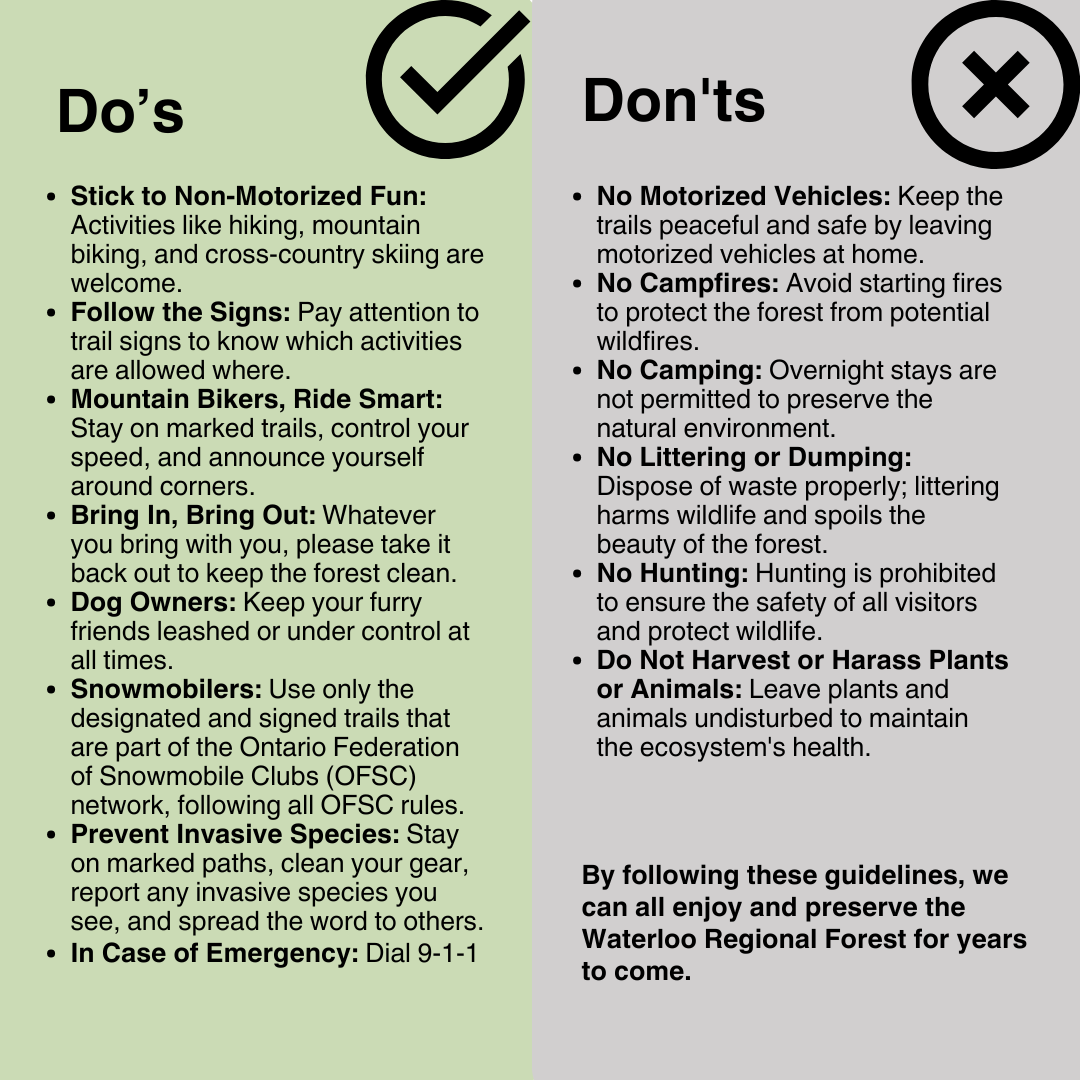
Here are some friendly reminders to keep it safe and fun for everyone:
Do's
Don'ts
By following these guidelines, we can all enjoy and preserve the Waterloo Regional Forest for years to come.
Our forests face challenges such as invasive species, pests, and climate change. Learn more about the measures we take to monitor and maintain forest health.
Do not move firewood – buy local, burn local
The movement of firewood is a leading cause of the unintentional spread of invasive tree pests and diseases. Insects, their eggs and fungal spores, often too small to detect, can hitch a ride on firewood, accelerating infestations that threaten both the environment and economy. To minimize this risk, is best practice to buy and burn firewood locally. Stay informed about firewood movement restrictions and the potential consequences of transporting infested wood.
Emerald Ash Borer (EAB) is an invasive insect that bores holes in ash trees with high mortality within years. As the larvae feed on inner bark of the tree, they disrupt the trees ability to transfer water and nutrients between foliage and roots resulting in mortality by girdling. EAB is prevalent throughout the Region and can be readily spread through short distance flights or the transfer of firewood.
The Region of Waterloo monitors Emerald Ash Borer throughout its Regional Forests. Infected trees pose a risk of falling due to compromised structure.
Formerly known as Gypsy Moth, Spongy Moth is an invasive moth that during its caterpillar stage, defoliates leaves of host trees, primarily hardwood species including Oak, Birch, Poplar, Willow, Maple and more. Outbreaks of this species are cyclical in nature with surges in population occurring naturally every 7-10 years. Outbreaks are influenced by biological and environmental factors such as warm winters and dryness in the spring. Naturally occurring pathogens will control populations to eventually collapse outbreak populations within 1-3 years.
The Region of Waterloo monitors for Spongy Moth within its Regional Forests to forecast future impacts of Spongy Moth.
Oak Wilt is highly destructive vascular disease caused by the fungus Bretziella fagacearum, posing a serious threat to Oak trees. The fungus spreads through the outers sapwood, restricting the tree’s ability to transport water and nutrients, often leading to tree death within a single growing season. This forest threat has not yet been detected within the Region of Waterloo, however, it has been confirmed within the province.
Hemlock Wooly Adelgid is a tiny, invasive, aphid-like insect that attaches to branches and feeds at the base of needles, extracting essential nutrients and sap. Once infested, hemlock trees do not recover and typically die over several years. This forest threat has not yet been detected within the Region of Waterloo however has been confirmed within the province.
Visit this webpage to stay informed about upcoming forest operations aimed at maintaining forest health and safety. These operations include tree planting, invasive species management, prescribed burns, and selective harvesting. Operations may result in temporary closures for public safety.
Have questions or need assistance? Your feedback will help guide the future management of our forests. Email our Regional Forester, Andrew Puchalski, R.P.F., or call 519-580-0296.
The Region of Waterloo regulates the destruction or injuring of trees in woodlands within the region through its Woodland Conservation Bylaw 08-026.The bylaw encourages sustainable forest management through the use of Good Forestry Practices.
In addition to the 16 Regional Forests maintained by the Region of Waterloo, there are many other trail networks that are great for walking, biking and nature appreciation.
Some well-known trails in Waterloo Region include the Iron Horse Trail and the Walter Bean Trail. A network of trails connecting the Waterloo Landfill Woodland and Petersburg Regional Forest provides excellent mountain biking opportunities.
The 2021 Bike Map is a summary of all bike infrastructure in the cities and townships of Waterloo Region. The map highlights public art, scenic historic bridges, and the Hydrocut trails (a premier mountain bike destination), in partnership with Explore Waterloo Region. Visit Explore Waterloo Region for up-to-date app-based route recommendations.
The Region of Waterloo is located within the Haldimand Treaty territory, a formally ratified agreement recognizing six miles on either side of the Grand River as belonging to Six Nations of the Grand River. These lands are also part of the Dish with One Spoon Wampum agreement, a commitment to sharing and caring for the land in a spirit of peace and mutual respect.
We acknowledge that the forests within the Region are deeply connected to the traditional knowledge, stewardship practices, and spiritual relationships that the Haudenosaunee, Anishinaabe, and Neutral Peoples have maintained with these lands and waterways for generations.
We honor the enduring presence, contributions, and philosophies of Indigenous Peoples in sustaining the natural world, and we are committed to learning from their expertise as we care for the Region’s forests today and into the future.
Contact Us
Region of Waterloo
150 Frederick St.
Kitchener, Ontario N2G 4J3
Telephone: 519-575-4400
Fax: 519-575-4481
For general inquiries:
Regionalinquiries@regionofwaterloo.ca
Search Region of Waterloo main site, Airport, GRT, Libraries, Museums here