Yes. Waterloo Region water is perfectly safe to drink. Water quality is highly regulated, and Waterloo Region’s water is of high quality. This is strictly a water supply constraint where demand outweighs available capacity. Visit our water quality webpage to learn more about how the Region monitors drinking water and ensures it is safe.
Information for the community
If you live in the Mannheim Service Area or elsewhere in the region, you may wonder what the water capacity constraint means for you. Please be assured that your drinking water is safe - it does not have any impact on the quality of water. It has to do with making sure we can get water to areas where future growth is planned. Below are answers to frequently asked questions about the constraint.
Is Waterloo Region water safe to drink?
Are residents being asked to conserve water?
Reducing water use is always important because it helps manage and protect the supply we have, especially during warm, dry weather. The community has done a great job to conserve over the years, and we will keep this up with your help. Visit the water conservation section of our website to learn more about the programs we offer and the annual bylaw that regulates outdoor water use.
What areas of the community are affected?
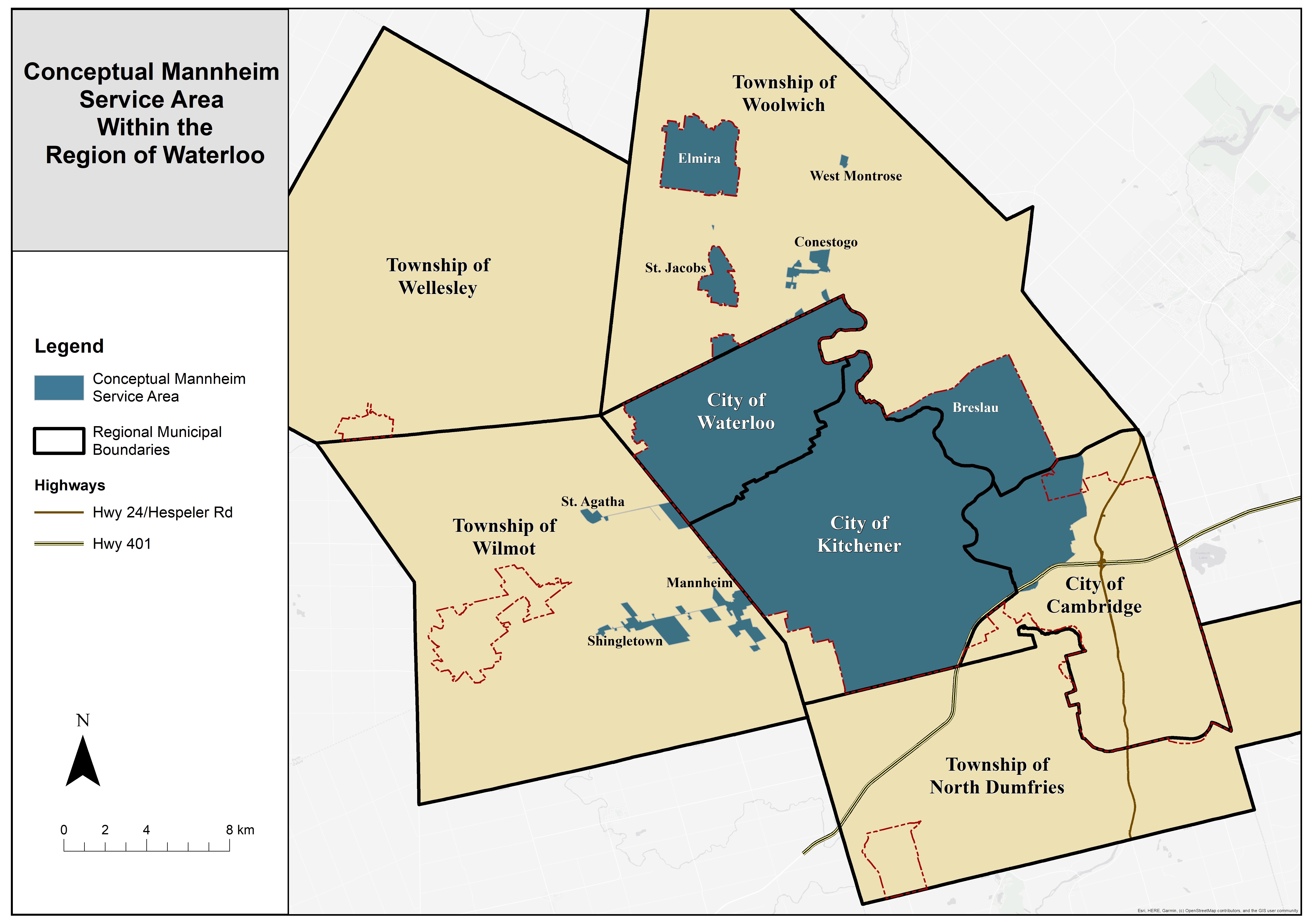
Kitchener, Waterloo and parts of Cambridge, Wilmot and Woolwich are affected. Below is a map of the areas supplied by the Mannheim Service Area. View a larger version of the map.

How was this constraint identified?
The water capacity constraint was identified through ongoing work to update the Water Supply Strategy. The strategy looks at our current water supply sources, assesses future water demand, and investigates possible new water sources.
While previous water monitoring reports have consistently shown adequate water supply capacity overall, it is important to note that a different methodology was being used to determine remaining capacity. Region staff identified a capacity constraint in the Manheim Service Area due to a combination of factors, including: use of a revised methodology, aging infrastructure, lower levels of water in the system, and the pressures of rapid growth.
An independent third-party reviewer verified staff technical findings and the changes in methodology on how to assess water supply capacity. The findings were shared at the Sustainability, Infrastructure and Development Committee of Regional Council on January 13.
How are we addressing the constraint?
The first step was to revise how we assess remaining water supply capacity to better suit our groundwater-based system. The revised methodology will accurately assess capacity for future development in Waterloo Region.
Steps have also been taken to work towards short and medium/long-term solutions to the constraint. This includes expediting timelines for new infrastructure and repairing aging assets, while engaging all partners to ensure a secure, sustainable water supply now and for the future. View the timeline of solutions for more details.
As we move forward, we will continue to work with area municipal partners to find ways to advance development. If you are a member of the development community, visit the Q&As related to development applications for more information.
If you’re looking to discuss a specific project, please contact regionaldevelopment@regionofwaterloo.ca or 519-501-6619.
Which technical experts are helping the Region to develop solutions?
Due to the urgent nature of the Mannheim Service Area water capacity issue, firms with considerable local knowledge of our water supply system, knowledge of water supply and treatment design, and knowledge of project delivery were approached to participate on an industry panel to help develop solutions. The panel includes the following firms:
- Associated Engineering
- CIMA+
- Colliers Project Leaders
- Dillon Consulting Limited
- R.V. Anderson Associates Limited
- Sahely Water Engineering Ltd. (SWEL)
- SLR Consulting
- Stantec
- Tree Frog Environmental
What is a sustainable water supply system?
A sustainable water supply system requires producing enough water to meet current demand and future growth, and having a capacity buffer for periodic repairs, maintenance and emergencies.
How do we assess capacity for future growth?
We previously assessed water capacity by using a methodology that looked at the Integrated Urban System (Mannheim and Middleton Service Areas) as a whole. This also looked at the maximum system capacity (the peak performance of a system) to determine the remaining water capacity in the system.
Moving forward, we will look at the capacity in the Mannheim and Middleton Service Areas individually, using both maximum system capacity and average sustainable capacity (the amount of water a system can reliably produce on an ongoing basis). It will also set an operational resiliency target (i.e. capacity buffer) of 20 per cent supply capacity.
Why are we changing how we assess water capacity?
A combination of factors impacts water supply capacity, including increasing frequency and duration of infrastructure shutdowns, a shift to increasing year-over-year water demand, plateauing of conservation efforts, and others.
This revised methodology is better suited to a groundwater-based system and more accurately reflects the actual capacity available in the Region’s water system today.
How does this impact growth today?
Construction of buildings with existing permits will continue as we work with our area municipal partners to find ways to advance development.
At this time, we are unable to support new commitments in the Mannheim Service Area. For development outside of the Mannheim service area, it is business as usual. See the FAQs related to development applications for more information.
If you have a specific question about existing and upcoming projects, please contact regionaldevelopment@regionofwaterloo.ca or 519-501-6619.
Do we have enough capacity for wastewater treatment to meet future growth?
The Region of Waterloo owns and operates 13 wastewater treatment plants that serve cities and towns across the region. These facilities treat the water entering the sewer collection systems before it is released back into local rivers. The Region's annual monitoring report, which details the capacity of these wastewater treatment plants, is available here: Region of Waterloo Water and Wastewater. As part of the upcoming Wastewater Treatment Strategy Update (WWTSU), staff will develop a plan to 2051 for upgrading or expanding the region's wastewater treatment infrastructure.
The water capacity information hub will continue to be updated to provide the most current information to the community. See the FAQs related to development applications for answers to common questions from the development community.
For those in the development industry looking to discuss existing and upcoming projects, please contact regionaldevelopment@regionofwaterloo.ca or 519-501-6619.